Faith
Written on 03 Nov 2025. Also cross-posted on UWCCF's Medium.
A reflection on faith and the beliefs that I hold close, subject to change as I grow. Structured to mirror Question 1 of the Heidelberg Catechism. Not that I am fully able to keep these daily, but a contextualization on what I believe is true. I believe that Christianity is not so much as a set of theological beliefs than it is a relationship with a personal, living and inexhaustible Creator.
What is my only hope in life and death?
Leaning on Christ through lived experiences of pain and suffering.
At some point, everyone dies. What happens after death is a mystery.
Some people say that we just recede into nothingness and lose consciousness for eternity. Perhaps they get that from the experience of sleeping - just losing consciousness as the world goes by around you. That's one way to look at it.
I think death is scarier than merely sleeping because we see shadows of it in our everyday lives -- in the form of sickness, ageing and suffering. And it becomes visceral, concrete when you attend funerals, go to the crematorium and bid a loved one goodbye. Stoicism doesn't work well, especially when family is crying all around you. We see the effects of sin and death in the form of suffering: circumstances that happen in the world, in your life, in the lives of everyone around you. Personally, in the past years it would've been through periods of National Service.
I dreaded every week of training school. There were some weeks that I would approach with much more apprehension than others. Objectively speaking, I was thinking too much about these experiences and that probably added some undue amount of stress. But that does not diminish the external suffering that I had to go through then.
Field camp, for instance, was just physical exhaustion and learning how to be gross and dirty and uncomfortable in the jungle for 5 days. MSTD was a whole different monster, with sleep deprivation for pretty much an entire month. On those wee mornings that my alarm rang and I did a mental calculation of the hours that I'd slept, my mind foggy with sheer exhaustion and the cabin tilting at an angle, I'd pray. I'd pray fervently for energy to see me through the next day. I wrote about it in a review of 2023.
I think that such experiences can be dealt with through sheer willpower and will, not thinking "so deep(ly)" about what we had to go through every day. Or I could have acted a little more irresponsibly and stolen more time to sleep during the sail, for instance. I'm saying so because that's what some of my batchmates did (not blaming them), and I'm pretty sure they felt that they didn't need a supernatural being to watch over them or watch over their plight.
My point is that these tough experiences showed me that I could lean on Someone, whom I knew to be a Personal God. He would bother answering my prayer not so much in spite of but because of His greatness, since He was so great and loving to send His Only Son to die for us.
Could I have imagined going through it without Him? Perhaps, yea. Would I have wanted to go through it without Him? No.
Time will diminish the intensity of emotions / feelings felt in the moment. But that doesn't mean that I can simply trivialize and forget about whatever I'd gone through in the past.
That I am not my own, but belong with body and soul, both in life and death, to my faithful Saviour Jesus Christ.
I belong to Christ and Christ alone.
We only see the glamorous parts of peoples' lives on social media. No one would broadcast their deepest sorrow, guilt or shame. Even if they did, one can hardly believe that posting was not for some ulterior motive.
When we fail at glamorous and self-glorifying things, we get incredibly bitter. The things that bring much happiness in our lives are the root of much dissatisfaction. I'm reminded of this every time I fall sick, and all the hard-earned aerobic fitness gains (hundreds of kilometres accrued over past months) all seem to come to nothing. As much as we want to believe that there are things more permanent than momentary success in whatever we do, we know that all things will pass away (1 Corinthians 7:31). Our jobs, our technical abilities, our families -- because of the temporal nature of this world, they too shall eventually cease to exist.
No one is spared from suffering, no matter how put together they appear. The Bible acknowledges that; we are broken and sinful by nature (Romans 3:23). Even amidst our striving to make the world a better place, to patch our uncleanliness and our brokenness, we fail miserably and in some instances, make it worse (Isaiah 64:6).
When we place our identity not in the things of this world (fame, status, possessions, wealth, relationships, etc.) and instead with a Being who is externally good and immutable, our worth is fixed. It does not fade nor change according to times, unlike the aforementioned things.2
How could we possibly do this? Not by our own strength, but through Christ.
— Philippians 3:8But whatever gain I had, I counted as loss for the sake of Christ.
What then can we pour into that will never fail to satisfy? Christ gives us a hope: one that is constant throughout the seasons of life, and will continually see us even through death. In happiness, sorrow, sickness and health, we are thankful.
However, this does not absolve us from the responsibility of living out our lives. We are justified by faith alone, through grace alone, yet the faith that justifies is never alone.
He has fully paid for all my sins with his precious blood, and has set me free from the tyranny of the devil.
Belonging to Jesus Christ and believing in his death reminds me of my worth in Him.
Why can we trust God to the extent of forgoing whatever we have? Because He paid the ultimate price for our sins on the cross. Though we sin and fail daily, He is faithful and just to forgive our trespasses1. We journey through this broken world, watching sin and suffering take place around us and affect the lives of those around us, yet we hope as a people living in the already but not yet (1 John 3:2).
We as Christians who have placed our hope and identity in Christ then are not self-assured. We must hold the knowledge that we were once eternally condemned; that no work of our own would have counted for our salvation. Our assurance lies in Christ, which gives us humility in acknowledging our depravity, attributing nothing of success to ourselves, but only through Christ and Christ glorified.
This is freeing, especially in a place like Waterloo, where nearly everyone is single minded on doing well either in academics or in finding their next co-op job with the eventual goal of progression in life. Any sort of comparison to the performance of others seeking to elevate my status (moral high ground, academic / career achievements, fitness PRs, etc.) is a slippery slope to forgetting what I place my worth in. Believing in Christ as the ultimate victory and my identity should free me to celebrate friends' successes, but I still struggle with this. To this, the only appropriate response to be of extreme thanksgiving.
— Psalm 8:4What is man that you are mindful of him, and the son of man that you care for him?
He also watches over me in such a way that not a hair can fall from my head without the will of my Father in heaven; in fact, all things must work together for my salvation.
Where He leads my feet, I shall not want or need.
— Romans 8:28And we know that for those who love God all things work together for good, for those who are called according to his purpose.
If we place our hope in a Creator who has formed our most inward being, then we know that He has a divine plan and purpose for us. And this gives reason to our pain, affliction and suffering. In fact, Thomas Watson in posits the following in All Things for Good: "These afflictions work for us a weight of glory, and shall we be discontented?...To be thankful in affliction is a work peculiar to a saint."
Out of the most poisonous drugs God extracts our salvation. I believe that any form of suffering is a refining fire (as covered through previous reflections in NS), and that all things must work together for my salvation.
Because I belong to him, Christ, by his Holy Spirit, assures me of eternal life and makes me wholeheartedly willing and ready from now on to live for him.
Empowered through Christ and the Holy Spirit
The Christian life is a challenging one. It is one in which we called to live in but not of this world. We live in constant reminder of how, despite our best efforts, our sinful selves constantly fall short of who God calls us to be.
Why then do we adhere to a standard that is unrealistic for us mortals to reach? The reasons are as follows:
- Not merely through blind faith, but trusting that as a father guides his child for the sake of nurturing his child, we too are growing steadily closer to the version of how He has intended for us to be. (Psalm 139:13)
- Following His commands out of love, rather than out of fear. We love because he first loved us. (1 John 4:19) We follow His commands because of His death and resurrection.
There is a distinction between the notion of joy and happiness. I've learnt that joy is something that is less temporal and a state of constant optimism, as compared to happiness, which is something to be felt in the moment. We as Christians labour through weakness and rejoicing, for in our present inability to live up to the will of God, His Power is displayed through our weakness. Though we are frail, we fix our eyes on the hope that is to come and find things to be grateful for, knowing full well that He will sustain us.
And we have the ultimate Hope because He has overcome death in His resurrection. (1 Peter 1:3)
Christianity is a religion welcoming those who are broken, shattered, and in need of a savior. It is a paradoxical yet supremely beautiful one: in which contradictory statements by conventional wisdom are true. I confess my simultaneous unworthiness and worth. When I am broken, I am made whole. In dying (to self), I am born to eternal life.
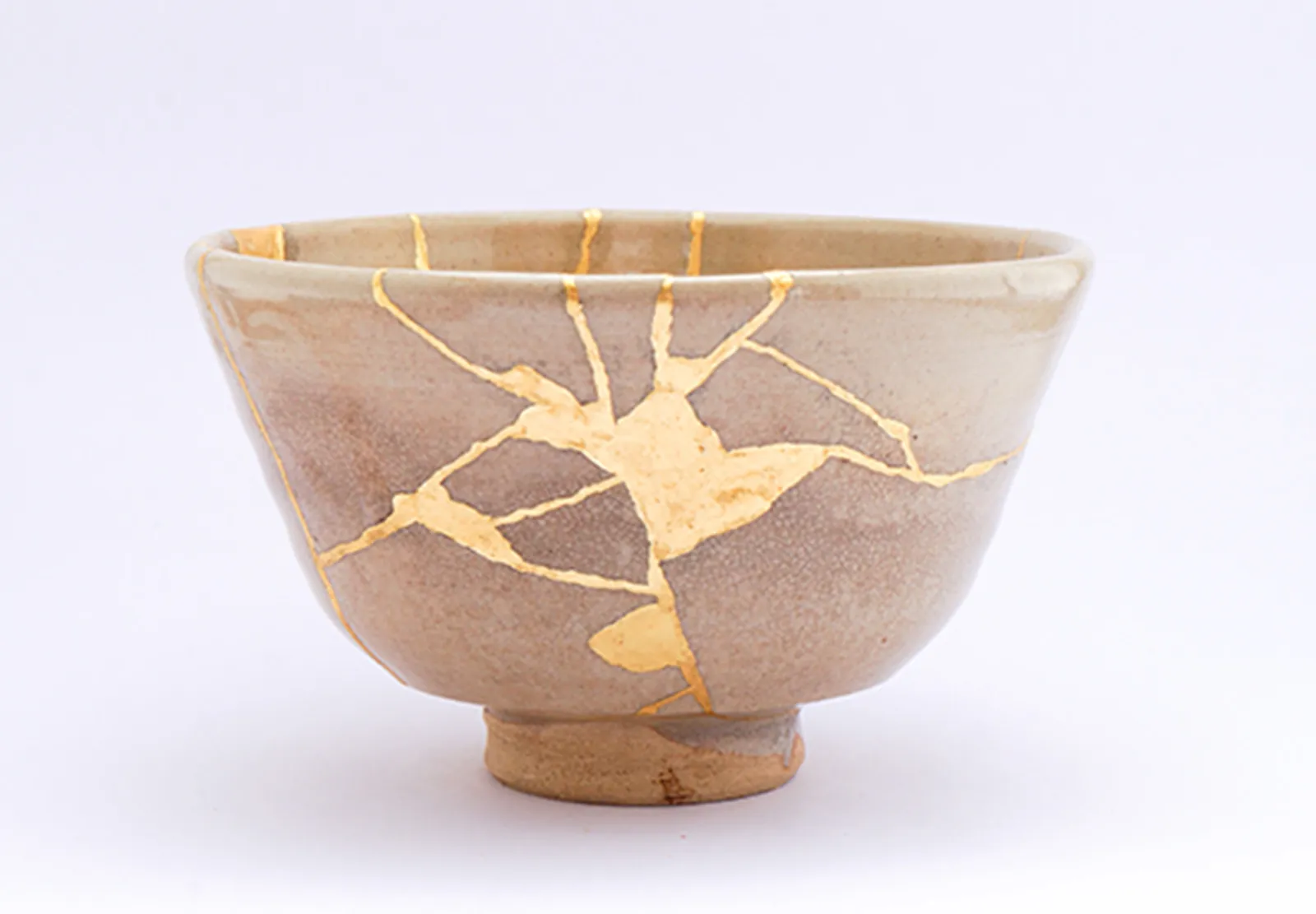
Kintsugi bowl — broken pottery repaired with gold
Notes
While the work of Christ on the cross has forgiven our sins past present and future, this does not give us reason to continue in sin. (Rom 6: 1-2) Turning from sin and living a life renewed in Christ must be an outworking of our faith.
Addendum: thanks Matt for pointing out how I could be clearer in my phrasing.